Why a Throw-In Can Change the Shape of an Attack
A throw-in can change the shape of an attack by fixing the restart point and opening passing angles. Learn how teammates create useful options.
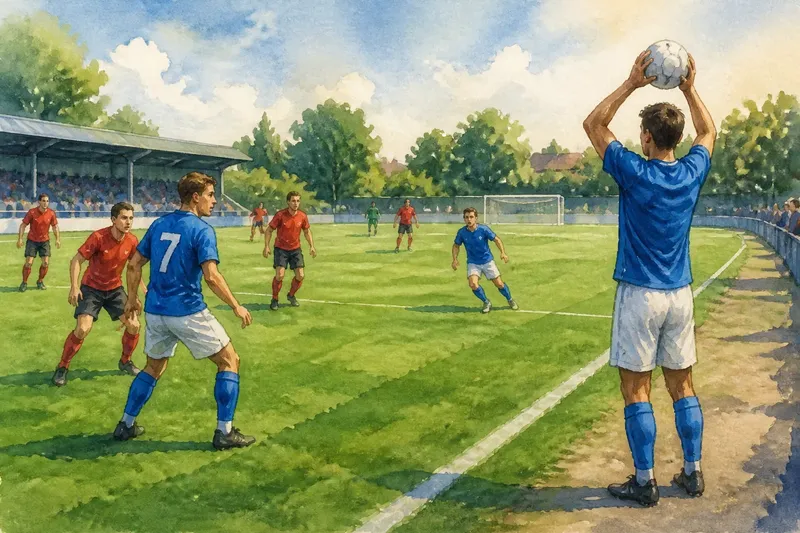
A winger stands with the ball above his head near the touchline, while a teammate checks toward him and another drifts into the space behind. That small pause is already shaping the next attack. A throw-in can change the shape of an attack because its fixed location gives both teams a clear reference point, and the players around it can arrange themselves to offer different routes forward.
Unlike an open-play pass, a throw-in begins from a spot the opponents can see and prepare for. The thrower has limited time to find a legal option, but the receiving player can move before the ball arrives. Here are seven ways that restart influences positioning, passing angles, and the attack that follows.
1. The touchline fixes the starting point
The thrower cannot move the restart to a more comfortable angle. The ball must come back into play from where it crossed the touchline, so the team has to build its options around that particular patch of grass. A throw-in near the attacking corner creates different possibilities from one close to the halfway line.
Because the ball begins at the edge of the field, the thrower has no teammate available on the touchline side. The useful passing space is in front, behind, or inside the receiver. A teammate who understands that geometry can arrive on an angle rather than stand directly in front of the thrower, where a marker can block both the pass and the next move.
The spot also limits what the defending team needs to watch. Opponents can crowd the likely receiving area, so the attacking side may spread out to pull them away or gather nearby to create short connections.
Before moving, note which directions remain open from the restart spot.
2. A short option can draw a defender out
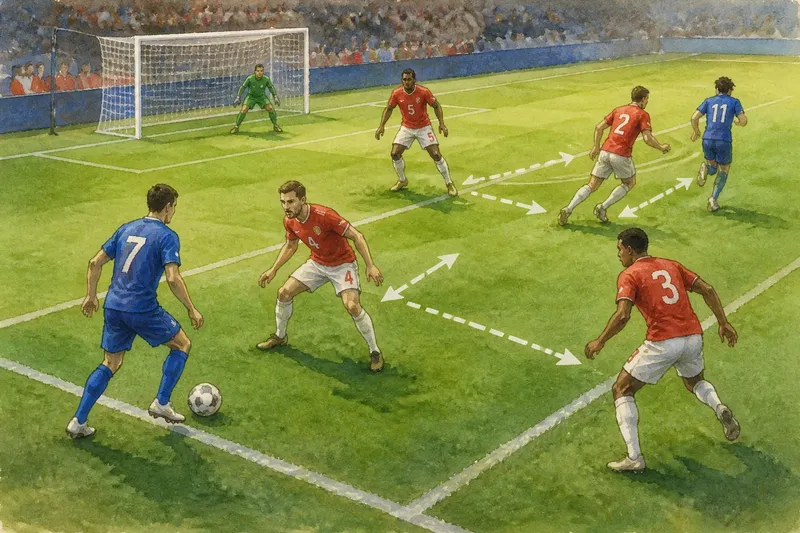
A player who checks toward the thrower offers a simple, visible target. That short option can be useful even if the intended attack is not a pass straight to that player. If a defender follows the movement, space may open behind the marker or inside the field.
The receiver does not have to turn immediately. A one-touch layoff to a nearby teammate can keep the ball moving while the first marker is still adjusting. The thrower can also step forward after releasing the ball, giving the receiver another possible link, provided the team keeps the movement coordinated.
Too many players coming short, however, can gather the attack in a tight cluster. Their presence may make the first pass easier to see but leave no forward option if the defense closes quickly. One short receiver often works best when another teammate holds a different distance or angle.
Offer the short pass to move a defender, not simply to stand near the ball.
3. A deeper run gives the thrower a forward lane
A teammate can move away from the thrower instead of toward the ball. That run may invite a longer throw beyond the first defensive line, especially if the player starts wide and angles inward as the ball travels. The route can make a direct pass more difficult to intercept than one aimed at a stationary target.
The player who runs deep should not be the only available option. If the thrower sees no nearby outlet, a defender may step up aggressively or the receiver may be forced to contest a difficult ball. A supporting teammate positioned underneath the run can collect a loose pass or help keep possession if the forward route is covered.
Imagine a team restarting near the attacking third. One forward checks toward the ball, a second begins a curved run behind the nearest defender, and a midfielder waits inside for a short return pass. If the defender follows the checking forward, the run behind may become more accessible; if the defense drops, the midfielder may have room to receive. The movements create choices, not a promised outcome.
4. An inside angle can connect the flank to the middle
Passing straight down the line is easy to anticipate when the receiver and thrower are both close to the touchline. A teammate positioned several yards inside can offer a diagonal target instead. Receiving there may let the player face the center of the field, where more passing directions are available.
This inside option can also help the attack avoid being pinned against the boundary. A player receiving with a defender on the back may use a short pass inward to a teammate arriving from deeper. The receiver’s body position matters: standing side-on can make it easier to see both the throw and the next pass.
The team still needs someone to preserve width. If every nearby player moves inside, the defense can compress the space and make the next pass crowded. A wide teammate can hold a position farther up the line, stretching the defensive shape even without receiving the throw.
Keep one player available inside and another capable of holding the width.
5. Staggered distances make the next pass less predictable
When several teammates stand at the same depth, they offer the thrower variations of the same pass. Staggered positions create a sequence of options: one player close, another a little farther forward, and a third beyond the first defensive line. The thrower can choose according to the defenders’ distance and body orientation.
Those layers also help the receiving player. A nearby teammate can provide a quick outlet, while a farther player occupies a defender who might otherwise close down the ball. If the first receiver cannot turn, the ball can travel backward or inward without forcing the team to start over from a crowded touchline.
Spacing is not just about how far apart players stand. A pair of teammates separated sideways can create a different passing angle from two players lined up one behind the other. The aim is to make the next action possible without bunching into the same channel.
6. Decoy movement can create room for the intended receiver
Not every run near a throw-in is meant to receive the ball. A player can move toward the thrower to attract a marker, then leave the space for a teammate arriving late. Another can run toward the line while the intended receiver moves inside. The defense must decide whether to follow the movement or hold its position.
For a decoy to help, teammates need to avoid making identical runs at once. If two players both rush into the same gap, they may bring defenders with them and crowd the intended route. A clear change of direction, timed with the throw, can make the movement easier for teammates to read.
These patterns are most useful when the team knows which player should receive and what support follows. Without that shared understanding, a convincing decoy may pull defenders away but leave the ball carrier isolated.
7. The restart location changes the value of risk
Near the attacking end, a team may choose to throw toward a crowded area because the ball is close to a scoring opportunity. Farther back, losing possession can expose the team to an immediate counterattack, so a safer pass to a teammate facing the field may make more sense. The location does not dictate one choice, but it changes what the team stands to gain or lose.
The score, time remaining, player strengths, and opponent’s defensive arrangement can also affect the decision. A tall forward may be a useful target for a direct throw, while a quick midfielder may benefit more from receiving into open space. The receiving options should suit the players available, rather than follow a pattern for its own sake.
Before the ball is released, the thrower can scan for the nearest defender, the most open lane, and the safest supporting player. Teammates help by making their intentions visible early instead of waiting until the thrower is under pressure.
What should players look for before a throw-in?
Can the thrower pass to a teammate who can see the field?
A receiver facing inward may have a clearer view of the next pass than one trapped with their back to the center. Teammates can create that angle by standing inside or approaching from a diagonal route.
Who is holding the space beyond the first defender?
A forward run can stretch the defense even if the throw does not reach it. Check whether another player is positioned to collect a short return or a loose ball beneath that run.
Are teammates crowding the same channel?
If several players gather beside the thrower, the defense can close that pocket quickly. One player can move away to provide a different distance or angle, leaving the others room to connect.
Does the restart location favor a safe pass or a direct one?
A throw near the opponent’s goal may reward a more ambitious delivery, while a deeper restart can make support and possession more valuable. Consider the surrounding space and the players available rather than choosing by habit.
How do the rules shape the available options?
The thrower must use the required throwing action and remain within the rules for the restart; teammates must also respect the applicable distance requirement for opponents. Those boundaries are why a throw-in is a specific restart rather than an ordinary pass from the sideline. For an actual match, check the competition’s current rules and the referee’s instructions.
Once the throw is legal, the tactical problem is about movement and angles. Players can create a close outlet, stretch the defense with a deeper run, or position themselves to receive inside. The thrower’s view of those options is often more useful than a complicated pattern that leaves no clear pass.
At your next match, watch the players who do not receive the throw. Their movement often reveals how the team plans to open its next passing lane. A throw-in can change the shape of an attack before the ball reaches anyone, simply by changing where teammates stand and which direction the defenders must protect.