The Match Ball Myth: Why One Ball Does Not Suit Every Setting
The match ball myth overlooks surface, weather, age and play level. Learn what football design features mean so you can choose a ball suited to its setting.
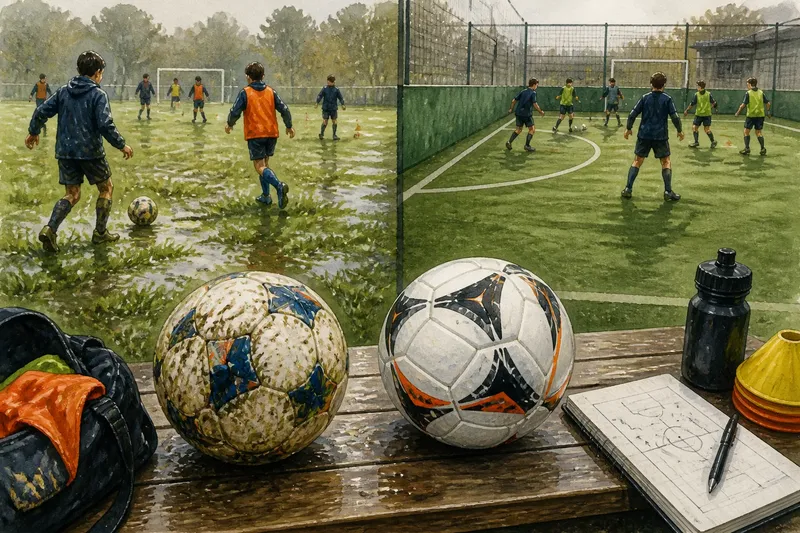
On a damp school field, a ball can pick up water and skid across the grass while players are still settling into the warm-up. The match ball myth—that one football suits every setting—starts to unravel when you look at what a ball is built to do and where it will be used.
Panels, casing, bladder and size all affect how a ball feels in play. A good choice is not necessarily the most expensive or the one used in a televised match; it is the ball that fits the surface, players and conditions you actually have.
What makes footballs feel different?
The outer panels form the surface players see and strike. Their shape and construction influence touch and flight, while the material beneath them helps determine how the ball responds to impact. Seams may be stitched, bonded or molded, and the finish can feel smooth, textured or grippy.
Inside, a bladder holds the air. Its material and construction affect how the ball retains its shape and how it rebounds. These features work together, so a label such as “match” or “training” is only a starting point—not a complete description of how the ball will suit your session.
Look for a clear product description that says what the ball is intended for, rather than assuming panel count or a glossy finish tells the whole story.
How should a ball suit its playing surface?
A ball used on natural grass faces different conditions from one used on artificial turf or a hard indoor floor. On grass, moisture, uneven patches and longer blades can change how the ball rolls. Turf can place more abrasion on the outer surface, while indoor courts reward a ball that behaves predictably on a firm, smooth floor.
Some indoor footballs are designed to rebound less, helping keep play close to the floor. They are not simply ordinary outdoor balls with a different name: the intended court and style of play matter. A ball made for a hard surface may wear quickly on rough ground, and an outdoor ball may feel lively in a small indoor space.
For mixed-use sessions, choose for the surface that will see most of the play, then check whether the manufacturer lists the ball for the other setting too.
What changes with weather and age?
Wet conditions can make a ball heavier in feel and slicker to control, while cold weather may make materials feel firmer. A textured outer surface can help with grip, but it cannot erase the effects of rain, mud or a poorly maintained pitch.
Players’ age and physical development matter as well. Youth balls come in different sizes and weights, and choosing the right one can make passing, carrying and shooting more manageable. A ball that feels comfortable to an adult may be awkward for a young player to control.
Check the age group and competition requirements before buying. Where the right choice depends on a label, manufacturer instructions or local rules, follow those rather than relying on appearance alone.
What should you ask before choosing a ball?
Is a match ball always better than a training ball?
No. Match balls are made for formal play, while training balls are intended for repeated use in practice; either can be suitable if its design fits the session. A training ball may make more sense for frequent drills, especially where the surface is demanding.
Does panel count tell me how a ball will fly?
Not by itself. Panel shape, joining method, surface texture and internal construction all contribute to how a ball moves, so a panel count cannot reliably predict its flight.
Can one ball work on grass and turf?
Some balls are listed for more than one surface, but suitability depends on the product design and how the surfaces are used. If most of your play is on turf, prioritize a ball described for that setting rather than assuming an outdoor label covers every pitch.
How do I know if a ball is the right size?
Check the size specified for the players’ age group and competition, then consider whether they can comfortably pass and control it. If the players span different age groups, separate balls may be more useful than asking everyone to adapt to one size.
How can a routine help you choose?
Use a simple routine over a week of planned play. Before the first session, note the surface, likely weather, players’ age group and whether the activity is a match or training; then compare those needs with the ball’s label and description.
- Before the week: Identify the main surface. If sessions include both grass and turf, note which one will get the most use.
- Before each session: Check the weather and pitch condition. If the ground is wet or unusually rough, use a ball intended for those demands rather than taking a delicate match ball by default.
- At the warm-up: Notice whether players can control the ball comfortably on the actual surface. If it skips, sticks or feels too lively for the activity, switch to a more suitable option if one is available.
- After play: Wipe away mud and moisture, then look for damage to the outer surface, seams or valve area. If the casing is separating or the shape has changed, set it aside for a closer check.
- Before the next session: Check the ball’s pressure according to its printed guidance. If it feels unusually soft or hard, adjust it within that guidance before play.
Say a community coach has a wet grass practice followed by a small-sided session on turf. They begin with a ball marked for outdoor training on the grass, then plan to use a turf-suitable option for the later session; the expected observable difference is a ball better matched to each surface, not a promise of perfect control.
What does a sensible choice come down to?
When comparing footballs, start with intended surface and player group, then consider whether the ball is for regular training or formal matches. Material and construction details help refine the choice, but they should answer a practical question: will this ball suit the conditions it is likely to face?
The match ball myth fades once you treat a football as equipment for a particular job. For a useful match ball choice, match its stated purpose to the pitch and players, and keep a different option for settings that ask something else of the ball.