From Cup Ties to Leagues: How Competition Formats Took Shape
Football competition formats give cups and leagues different season-long stories; learn why knockout rounds reward survival while leagues reward consistency.
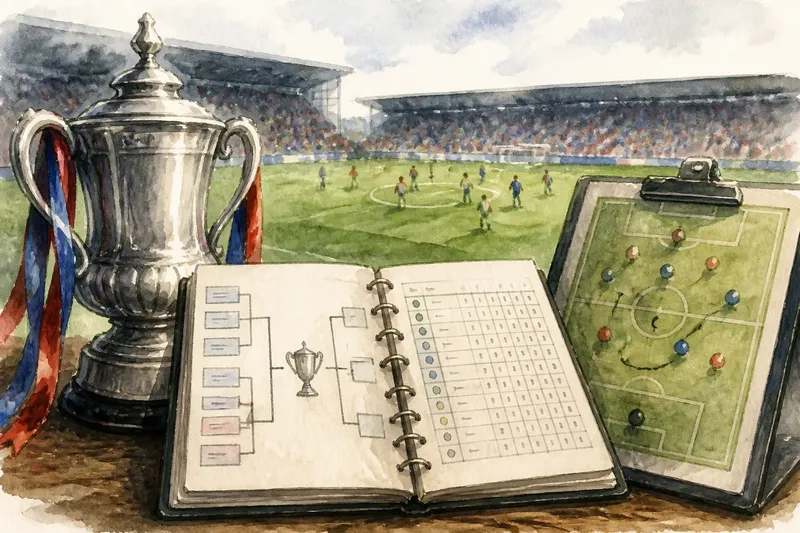
On a Saturday, a supporter might watch a club celebrate a cup win, then check the league table to see whether the same club has climbed a place. Both results matter, but they answer different questions. Football competition formats shape what counts as progress: a cup asks who can survive a sequence of ties, while a league asks who can sustain a campaign.
Those formats grew from different practical purposes. Cups offered a way to bring teams together in a contest that ended with one winner; leagues created repeated fixtures that could compare performance across a season. Understanding that distinction makes the calendar, the stakes and the drama easier to read.
Why did football develop two kinds of competition?
A knockout cup can be organized as a finite chain of matches. Teams enter a draw, play an opponent, and either advance or leave the competition. That structure suits a tournament with a clear ending and a final that can crown a champion.
League competition solves another problem: how to judge teams that meet repeatedly over a longer span. A table records the accumulated outcome of those fixtures, so one poor afternoon need not erase a strong campaign, and one brilliant match cannot by itself settle the title.
The formats also make different demands on organizers. A cup needs a way to pair teams and resolve ties; a league needs a schedule in which every participant has a fair set of opponents. As football spread across more clubs and regions, both arrangements offered useful ways to create meaningful competition.
What does a cup tie reward?
A cup tie is a match with an immediate consequence: continue or go out. That sharp edge gives even a single meeting a strong identity. A team may be eliminated despite controlling much of the play, while an opponent that defends patiently and takes its chance can move on.
Some cup competitions use one match per round; others use two legs, with each team hosting once. A two-leg tie asks which side performs better across both meetings, though the rules for resolving an aggregate draw depend on the competition. A final may be played at a neutral venue, adding a destination match to the tournament’s story.
The draw itself can influence the route. Depending on the competition’s rules, teams may be drawn freely or placed into seeded groups, and some rounds may include teams entering at a later stage. These choices affect who can meet and when, but the central cup logic remains elimination.
For a viewer, the useful question is not simply “Who was better?” Ask instead: “What did each team need from this particular tie?” That points attention to the score, the stage of the competition and whether a second meeting remains.
What does a league reward over time?
A league turns many individual fixtures into one continuing record. Teams typically earn points for results, and the table ranks them according to the competition’s published rules. The exact points system and tie-breakers can vary, so a close table is best read alongside its regulations.
Most league schedules are designed so clubs face the others in the competition, often at home and away. Repeated meetings broaden the comparison: a side has to respond to different opponents, travel, injuries and changes in form rather than solve one isolated puzzle.
That accumulation makes the table a story of endurance. A team may recover from an early stumble, while another can lose ground through a run of draws. The league’s winner is not necessarily the side with the most memorable single performance, but the one that finishes best under the competition’s scoring rules.
Look at a club’s position together with its remaining fixtures; the place alone does not tell you how much of the story is still unwritten.
Why can the same club feel different across both formats?
A club competing in a league and a cup is living through two kinds of pressure at once. The league rewards a dependable baseline; a cup tie may call for a bolder gamble because there may be no later fixture to repair a cautious approach.
Imagine a fictional club that has a narrow lead in a league match but faces a cup replay a few days later. Its coach might choose a conservative plan in the league to protect the result and rotate some players for the cup, expecting fresher legs to help in the next tie. The observable effect could be a less adventurous league performance followed by a faster start in the cup, though the choice also carries risks if the league match remains unsettled.
That tension is part of why competitions overlap rather than replace one another. A cup can offer a route to a trophy outside a club’s league position, while league form provides a longer measure of the team’s strength. Neither result cancels the other; they describe different accomplishments.
How do promotion and relegation change the league story?
In many football systems, league tables connect divisions. Strong finishers may move up, and teams at the bottom may move down, either automatically or through a playoff. This means a league campaign can be about survival or advancement as well as the title.
Promotion changes the scale of the next season: a club must face opponents from a higher division and adjust to a new competitive setting. Relegation brings a different reset, with the club entering a lower division and its schedule changing. The exact mechanism, number of places and playoff arrangements are set by the competition, not by one universal football rule.
For supporters, the lower end of the table can therefore carry its own suspense. A late-season match between clubs near the relegation places may have a different emotional weight from a cup final, yet both make the format’s purpose visible: one decides a season’s standing, the other decides who advances.
What questions help make sense of a competition format?
Why does a cup have a draw?
A draw assigns opponents for a round, giving the tournament its route from a large field toward a final. Whether it is open, seeded or adjusted for geography depends on that competition’s rules.
Why can a cup team be eliminated after one loss?
In a single-match knockout round, the losing team has no further tie in that cup, so the winner advances. Some competitions use two legs or other arrangements, which can change when elimination is decided.
How does a league decide who finishes higher?
Teams are ranked using the competition’s table rules, commonly points first and then specified tie-breakers if teams are level. Check the published regulations to see which measures apply in that league.
Can a club win the cup but finish low in its league?
Yes. A cup is decided through its knockout rounds, while the league position reflects results across its own schedule. Success in one format does not automatically determine a club’s standing in the other.
How can you read a season without mixing up its contests?
When checking a fixture list, start by identifying the competition beside the match. Then ask what a win changes: a league result affects the table, a cup result may send a team through, and a playoff may decide promotion or a final place.
Next, check the stage. A cup match early in the tournament and a final share the same elimination logic but not the same distance from the trophy; a league fixture near the beginning and one near the end count under the same table rules but can carry different practical pressure.
Competition formats give football more than different ways to crown winners. They let a season hold a long test of consistency alongside brief, high-stakes routes to a trophy. Once you know which question each format is asking, a table, a draw and a final stop looking like competing measures and start reading as distinct parts of the game.
When a result seems surprising, check the format before judging what it means: a defeat may end a cup run, shift a league position, or do both in the same afternoon.