Back Three or Back Four: Two Ways to Set a Defensive Line
Compare a back three or back four by tracking who covers width, depth, and runners, so you can read a team’s defensive shape as play shifts.
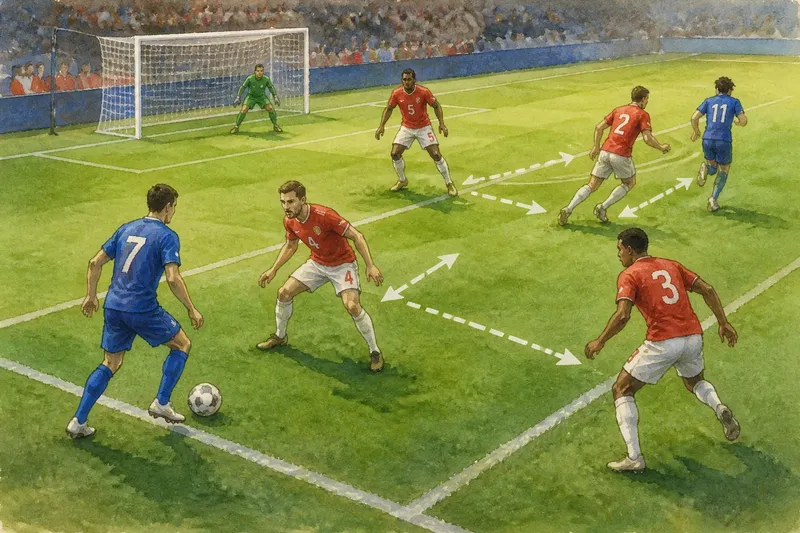
A winger receives the ball near the touchline, and the defensive shape appears in a moment: a center back steps across, a fullback tracks a runner, and another defender covers behind. To understand a back three or back four, watch who protects each space as the ball moves, not just how many shirts are in a line.
Both shapes aim to crowd the route to goal while giving defenders clear jobs. A back three can add central cover; a back four divides responsibility between two center backs and two fullbacks. Neither works alone: midfield pressure, wide players, and movement all affect how secure the line looks.
What does the number in a defensive line mean?
The number refers to the defenders forming the deepest line, not the whole formation. A back four commonly has two center backs between two fullbacks. A back three usually has three central defenders, though their positions can shift during play.
Formation graphics can make these shapes seem fixed. A team may defend with a back four and attack with a back three if a fullback moves forward and a midfielder drops between the center backs. To identify the defensive line, watch the team without the ball and count the players chiefly responsible for protecting the space nearest their goal.
Watch the wide players, too. A nominal back three may defend with wingbacks dropping alongside the central defenders, forming a line of five. That temporary shape shows how the team covers the opposition’s width; it does not change the team’s starting label.
How does a back four divide its work?
In a back four, the center backs usually share central duties. One can engage the forward or step toward the ball while the other covers behind. Fullbacks protect the channels between the center and touchline, and they may move outward to confront wingers. If a fullback advances, another player needs to help guard the space left behind.
The arrangement can be easy to read because each side has a fullback connected to a center back. But the line must respond when an opponent overloads one flank. A winger may hold the fullback wide while a midfielder or forward runs into the channel between fullback and center back. The defenders must decide who follows the runner and who protects the middle.
A back four can also compress toward the ball. When play moves to one side, the far-side fullback may tuck closer to the center backs instead of staying beside the touchline. This crowds the central area, but the team still needs to account for an opponent waiting on the far wing.
What changes with a back three?
Three central defenders can add cover in the middle and help track forwards. The outside center backs may move toward the channels to meet an attacker, while the central defender stays available to cover behind. This division can help when an opponent uses two forwards or makes frequent runs through the middle.
The wide players are often wingbacks, expected to cover the flank and support attacks. If they drop deep, the team can form a line of five. If they stay higher, the three center backs must stretch toward the touchlines when the opposition moves the ball wide, leaving greater distances between defenders.
That distance is a central trade-off. A third center back can add central cover, but does not automatically solve problems on the wings. If a wingback is caught ahead of the ball, an outside center back may have to defend a wide area, and the remaining defenders must adjust around the space he leaves.
How do the shapes handle width and depth?
Width is the space from one touchline to the other; depth is the space between the defensive line and the goal, as well as the space extending toward the opposition. A back four often assigns the touchline channels directly to its fullbacks. A back three may rely more on wingbacks, whose starting height can change from one phase to the next.
Depth also depends on how far the line stands from its goalkeeper and whether defenders move together. A high line can help keep the team compact and limit room between midfield and defense, but it leaves space behind for a forward to run into. A deeper line protects that space while giving opponents more room to receive the ball in front of it.
The number of defenders does not decide the line’s height. A coach can use a high or deep line with either shape. Watch the gap between defenders and midfielders, then notice whether the back line steps up together when the ball travels backward or drops together when an opponent threatens to run in behind.
What should you watch when the ball changes sides?
Switches of play reveal whether a defensive line can shift together. As the ball travels across the pitch, defenders should move toward it while keeping enough cover near the far side. If one player stays still or steps forward alone, an opponent may find a passing lane through the uneven line.
Imagine a team defending in a back four. Its right fullback is drawn toward a winger, and an opposing midfielder runs into the right channel. The right center back moves outward to meet the runner, the other center back covers centrally, and the left fullback narrows. The visible result is a protected middle as the line shifts; the defenders do not need to stay in fixed positions.
In a back three, follow the outside center back when an attacker drifts wide. Does a wingback recover to help, or does the outside center back leave the central defender exposed to a forward? Those movements show how the team shares the work more clearly than its formation label.
Which questions help identify a team’s defensive line?
Does a back three always become a back five?
No. Wingbacks may drop alongside the three center backs when the team is under pressure, but they can start higher when it wants to challenge for the ball or threaten a counterattack. The shape depends on the phase of play.
Can a team switch between a back three and a back four?
Yes. A fullback can move into midfield or forward while a midfielder drops into defense; those rotations can change the line without a substitution. Check the team’s positions when defending instead of relying only on the announced formation.
Is one defensive line better against two strikers?
A back three can give defenders an extra central player to share attention between two forwards, but a back four can handle them through coordinated marking and midfield support. The useful question is whether one defender remains available to cover while another engages the ball or a runner.
Why do defenders move toward the touchline?
They may be closing down an attacker who has received the ball wide or covering a run into the channel. The rest of the line then shifts to protect the space that player has left, often with midfielders helping to prevent a pass back inside.
What matters more than the formation label?
Pay attention to the distance between defenders, the support they receive from midfield, and how they respond when someone is pulled out of position. A back four without cover can leave a center back isolated; a back three with disconnected wingbacks can expose the flanks. The same starting shape can look secure in one phase and stretched in another.
When comparing a back three or back four, choose one player to follow through a change of possession. Notice where that player starts, which opponent they engage, and who covers the space behind. This small habit makes the defensive line easier to read than a formation graphic alone.
The most useful clue is the team’s next adjustment: when one defender steps out, see whether another fills the gap. That response reveals how the players share their responsibilities, whatever number the formation label gives them.